
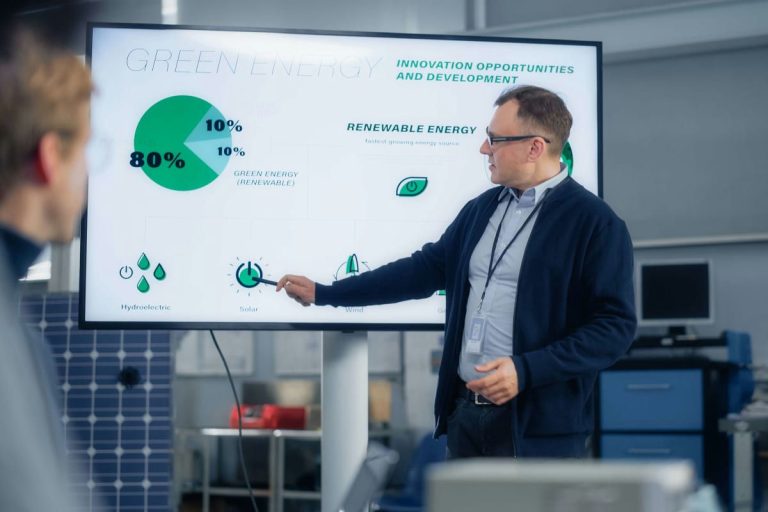
In a world facing growing environmental challenges, education plays a crucial role in introducing younger generations to sustainable practices. Green technologies, which encompass innovations such as renewable energy, resource management, and environmentally friendly practices, are becoming increasingly important in education. Their integration into school curricula is a proactive response to current and future environmental concerns. The rise of green technologies in education is based on several fundamental reasons. Firstly, they promote ecological awareness among students. Facing issues like climate change and pollution, it is essential to educate citizens who are aware of these challenges from a young age. Green technologies enable students to understand the key scientific and technical concepts underlying sustainability efforts. Secondly, the inclusion of green technologies in school curricula strengthens STEM (Science, Technology, Engineering, Mathematics) skills. Students exposed to these subjects develop valuable skills for their future careers. These skills are increasingly in demand in the job market, where professions related to the environment and green technologies are experiencing rapid growth. Finally, educational projects centered around green technologies encourage innovation and creativity. Students often participate in practical projects, such as building solar panels or designing recycling systems, which stimulate their interest in solving real-world problems. This active learning approach often leads to exciting discoveries and better retention of learned concepts. In conclusion, the importance of green technologies in education cannot be underestimated. They are necessary to educate students about environmental challenges, strengthen STEM skills, and encourage innovation. Schools, teachers, and policymakers must strive to integrate these technologies into educational programs to prepare young people for a more sustainable future.
Around the world, various initiatives are taking shape to integrate green technologies into educational programs. These efforts are often led by governments, non-governmental organizations (NGOs), and educational institutions, all aware of the environmental urgency. One notable initiative is that of the European Union, which has launched several programs to promote environmental education. The Erasmus+ program, for example, funds cross-border educational projects that include themes such as renewable energy and sustainable practices. This program enables schools to collaborate with European partners to share knowledge and resources, facilitating the integration of green technologies into school curricula. In the United States, initiatives like the Department of Education’s Green Ribbon Schools program encourage schools to adopt sustainable practices. This program recognizes establishments that succeed in reducing their environmental impact, improving student health, and providing quality environmental education. Awarded schools often serve as models for other institutions seeking to integrate green technologies. In Asia, countries like Japan and South Korea are leading ambitious initiatives to integrate green technologies into their educational systems. The Japanese government supports school programs that include courses on renewable energies and waste management. In South Korea, the Eco-School initiative offers grants for school projects focused on sustainability, encouraging schools to adopt green practices. Africa is not left behind, with several NGOs working to integrate green technologies in schools across the continent. For instance, the Solar Schools program in Sub-Saharan Africa aims to provide solar panels to rural schools, thus offering access to electricity while enriching educational programs with knowledge about solar energy. These initiatives show that there is a global awareness of the necessity to integrate green technologies into education. They provide valuable frameworks and resources for schools wishing to engage in this path. However, the success of these initiatives often depends on public policy support, financial investments, and adequate teacher training.
Several concrete examples illustrate how green technologies can be successfully integrated into school curricula. These case studies show the positive impact of these technologies on education and raising students’ awareness of environmental issues. The Bronx Design and Construction Academy High School in New York has launched a unique program focused on green technology training. Students learn to install and maintain solar panel systems and other energy management technologies. This initiative offers students valuable hands-on experience and prepares them for careers in renewable energy. The projects carried out by the students have not only reduced the school’s energy consumption but also served as models for other institutions wishing to follow this path. In Germany, the Ökohaus Gymnasium, a secondary school located in Berlin, has integrated a comprehensive green program into its curriculum. Students take courses on subjects such as biodiversity, renewable energies, and sustainable agriculture. The school also has an ecological garden where students can directly apply the knowledge acquired in class. This total immersion in green technologies has transformed the educational experience, making it more concrete and engaging. The International School of Copenhagen in Denmark is another model of integration of green technologies. The school uses a positive-energy building, meaning it generates more energy than it consumes. Students learn not only about the functioning of the technologies used, such as solar panels and geothermal heating systems, but are also encouraged to propose improvements and innovations to make the school even more sustainable. This innovative educational model places students at the heart of sustainability action. In Australia, the BYO (Bring Your Own) Green Tech initiative encourages students to bring their own eco-friendly technological devices to school. Projects range from portable solar energy to water recycling devices. This approach encourages students not only to use green technologies but also to become innovators in sustainability. The success of this initiative has inspired other schools across the country to adopt similar programs. These case studies demonstrate that with the right resources and adequate support, integrating green technologies in schools is not only possible but also beneficial. They highlight the diversity of approaches and emphasize the importance of adapting to the specific needs and contexts of each educational establishment.
Integrating green technologies into school curricula is not without obstacles. Various challenges arise, ranging from financial constraints to cultural resistance. However, innovative solutions enable many schools to overcome these obstacles and successfully adopt green programs. One of the main challenges is the high initial cost of green technologies. Solar panels, water management systems, and other technologies often require substantial investments. To overcome this problem, some schools choose to seek grants and partnerships with private companies. For example, companies specializing in renewable energies can provide equipment at reduced prices or sponsor educational projects. Governments and NGOs also offer grants to support green initiatives in schools. Another challenge is the lack of teacher training. To effectively integrate green technologies into courses, teachers must be well-trained and comfortable with these new technologies. Continuing education programs and professional development workshops are effective solutions to fill this gap. Additionally, sharing educational resources and good practices between institutions can accelerate this learning process. Cultural constraints and resistance to change can also hinder the adoption of green technologies. Some communities may be reluctant to change their educational habits or invest in innovations they are unfamiliar with. To resolve these issues, it is crucial to raise awareness not only among students but also among parents and the surrounding community about the benefits of green technologies. Schools can organize information sessions, open houses, and practical demonstrations to show the concrete benefits of these technologies. The already overloaded curriculum is often cited as an obstacle to integrating green technologies. Teachers may feel that there is simply not enough time to include new materials. One solution to this problem is interdisciplinary integration, where sustainability and green technology concepts are incorporated into existing subjects rather than adding new courses. For example, a science lesson can include principles of renewable energy, while a mathematics course can use energy consumption data for statistical exercises. Finally, monitoring and evaluating green programs pose a challenge. Measuring the impact of green technologies on students and the environment can be complex. Schools can use key performance indicators (KPIs) to track progress. For example, measures such as reducing energy consumption, increasing student participation in green projects, and surveys on students’ attitudes and knowledge about environmental issues can provide valuable data. In summary, despite the challenges, solutions exist to foster the adoption of green programs in schools. With a thoughtful approach and concerted efforts, it is possible to overcome obstacles and integrate green technologies effectively and sustainably.
Green education continues to evolve and inspire significant changes in pedagogical practices and school curricula. The future prospects for green education are promising, and several emerging trends indicate an increased integration of green technologies into global educational systems. One notable trend is the growing adoption of digital technologies for learning ecological concepts. Online learning platforms and educational apps offer new opportunities to integrate green technologies into teaching. For example, augmented reality (AR) apps can simulate sustainable environments, allowing students to explore ecosystems or understand the impact of renewable energies in an immersive and interactive way. Another promising development is the expansion of educational initiatives focused on projects and practical experiences. Project-based learning approaches encourage students to identify and solve real environmental problems. These initiatives not only promote active learning but also community engagement. For example, projects such as creating community gardens or recycling systems at school allow students to see the direct impact of their actions on their immediate environment. Partnerships between schools and companies specializing in green technologies are also expected to multiply. These collaborations can provide educational resources, internships, and mentoring opportunities for students. Companies in renewable energy, recycling, and water management sectors have a vested interest in supporting green education to train the next generation of skilled and environmentally-conscious workers. It is also worth mentioning the growing importance of initiatives for evaluation and certification of green school programs. Certifications such as LEED for Schools (Leadership in Energy and Environmental Design) offer official recognition of schools’ efforts to adopt sustainable practices. These labels can encourage institutions to further engage in green education and serve as a model for other institutions. Research and development (R&D) in green technologies will continue to influence education. Innovations in energy storage, sustainable materials, and resource management will provide new content and opportunities for school curricula. For example, the emergence of new, more efficient solar technologies could be the subject of specific modules in science and technology programs. In conclusion, the future prospects for green education are vast and inspiring. With the evolution of digital technologies, the rise of project-based learning, partnerships between schools and companies, and advancements in research and development, opportunities to integrate green technologies into educational programs are more numerous than ever. The challenge for educators and policymakers will be to stay at the forefront of these trends and adopt flexible and innovative approaches to prepare students for a sustainable future.